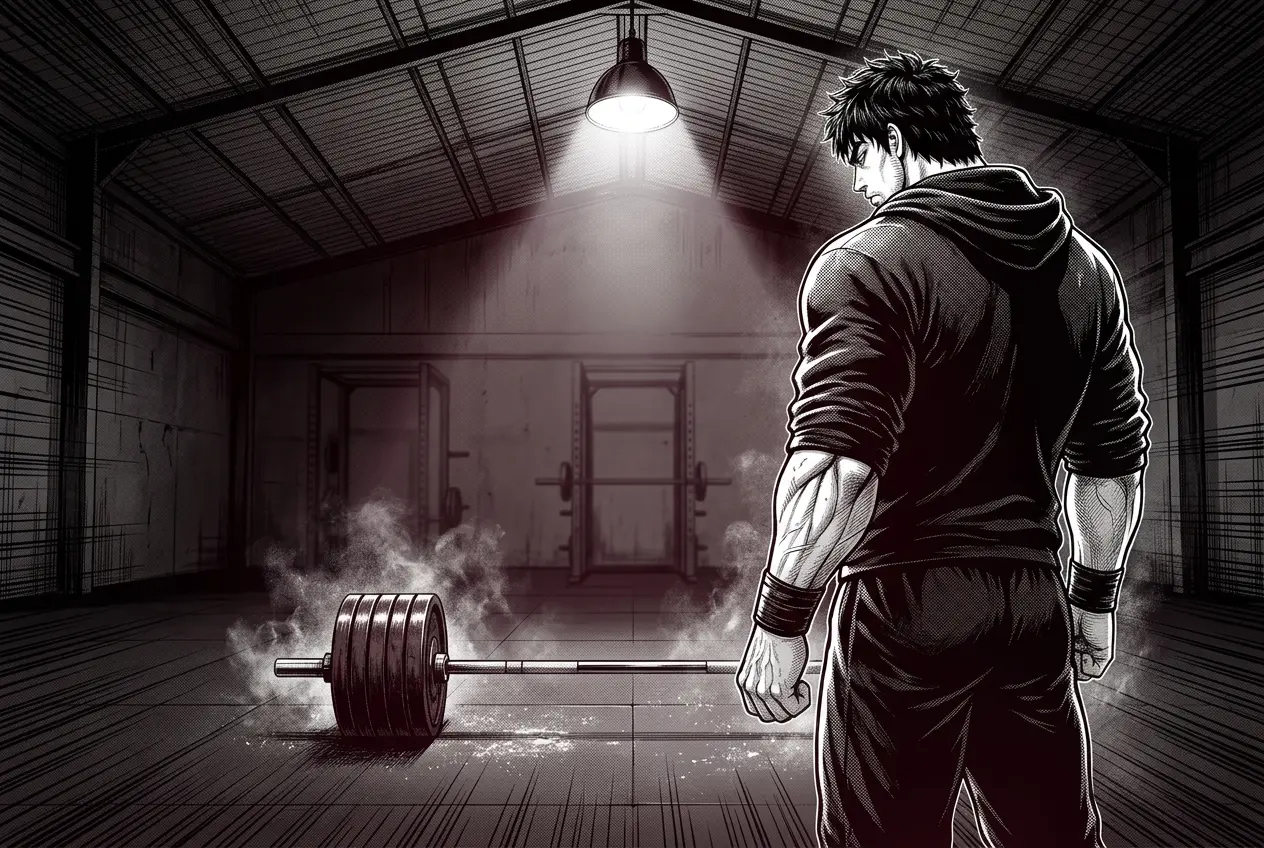
The Training Arc
The Training Arc: How to Rebuild Yourself When You've Always Been the Big Guy
You've been big, you've gotten strong, and now you want to change your body. Here's how to approach fat loss and recomposition without pretending you're starting from zero.
Key takeaways
- 1.Strength and excess body fat can coexist; many bigger lifters are not starting from zero.
- 2.Track fat mass, waist, strength and health markers—not just the scale.
- 3.Resistance training and adequate protein have the strongest human evidence for keeping muscle while losing fat.
Great transformation stories rarely begin with the main character already becoming who they want to be. There is usually a stretch where they are strong in one way and unfinished in another.
That is a useful way to think about body recomposition. You may already have muscle. You may already know how to train. You might have been the big kid, the strong fat guy, the one people asked to help move a couch—the lifter who can pull serious weight and still doesn't like what he sees in the mirror.
The next phase isn't becoming a completely different person. It's learning how to use what you've already built.
The big-guy advantage nobody talks about
Carrying more body mass for years is itself a form of loading. Add real resistance training on top and many bigger lifters end up with meaningful muscle and strength—sometimes more than leaner people who have trained for the same length of time. Strength and excess body fat can coexist in the same body, and that combination is common in gyms.
This varies a lot between individuals. Age, genetics, training history, sleep, medical conditions and medications all shape how much muscle someone carries. But if you have been lifting for years, it is reasonable to assume you are not starting from zero—and your plan should reflect that.
Your goal isn't just "lose weight"
The scale measures everything at once: fat, muscle, water, glycogen, food in your gut. It is useful, but it is one scoreboard among several:
- Scale weight — total body mass; noisy day to day.
- Fat mass — the thing most people actually want to reduce.
- Lean mass — muscle, organs, bone and water; the thing you want to keep.
- Waist circumference — a practical proxy for abdominal fat linked to cardiometabolic risk.
- Strength — whether your lifts hold or climb.
- Conditioning — how well you recover between sets, climb stairs or play with your kids.
- Health markers — blood pressure, blood glucose, lipids and others your clinician can measure.
A recomposition phase can look slow on the scale while your waist shrinks and your lifts hold. Tracking several of these gives you a truer picture than any single number.
Stop trying to finish the arc in one episode
Weight change doesn't follow the simple "3,500 calories per pound" rule most people learned. Modelling work from the U.S. National Institutes of Health shows that as body weight falls, energy needs fall too, so progress naturally slows over time (Hall et al., Lancet 2011).
Very aggressive deficits can produce fast early results, but they tend to be harder to sustain, and they make training feel worse. A meta-analysis of resistance-training studies found that energy deficits were associated with blunted lean-mass gains compared with energy balance, although strength gains were less affected (Murphy & Koehler, 2022). Evidence level — human trials, pooled: larger deficits make building or keeping muscle harder. What it does not establish: a specific calorie target for you. That depends on your body, health and goals, and is worth discussing with a clinician or registered dietitian.
Keep the muscle you fought for
The single most reliable signal to hold onto muscle while losing fat is to keep lifting with real intent. Resistance training tells your body the tissue is still needed.
Protein matters too. A widely cited meta-analysis of 49 randomized trials found that protein supplementation augmented resistance-training gains in muscle mass and strength, with benefits plateauing at moderate-to-high intakes (Morton et al., BJSM 2018). Evidence level — human randomized trials: adequate protein plus training supports lean mass. It is not magic and more is not endlessly better.
Recovery is part of the same equation. Training volume that felt fine at maintenance can feel crushing in a deficit. Adjusting volume, keeping key lifts heavy and prioritizing sleep lets you keep the stimulus without burying yourself.
Cardio isn't punishment
Somewhere along the way, a lot of bigger lifters learned to see cardio as the price paid for eating. That framing makes it miserable and easy to quit.
Cardiovascular fitness is its own asset: it helps you recover between sets, supports heart health and makes daily life easier. U.S. guidelines recommend at least 150 minutes a week of moderate aerobic activity plus muscle-strengthening work on two or more days (CDC). Daily steps count too. A meta-analysis of prospective cohorts found that more steps per day were associated with lower all-cause mortality, levelling off at higher step counts (Paluch et al., Lancet Public Health 2022). Evidence level — observational: associations, not proof that steps alone cause the benefit.
Walking is low-impact, easy to recover from and doesn't compete much with heavy lifting. For many big lifters it is the most underrated tool available.
Appetite is biology too
Hunger is not a character flaw. Body weight is shaped by genes, hormones, sleep, stress, medications, the food environment and behaviour—not willpower alone (NIDDK).
Hormones from the gut, fat tissue and brain signal fullness and hunger. After weight loss, several of these signals shift in the direction of eating more—a topic we cover in Arc 02: The Plateau Arc. Recognizing appetite as biology doesn't remove responsibility, but it replaces shame with strategy: higher-protein meals, more fibre, planned food, better sleep and an environment that doesn't fight you.
Where peptide and metabolic research enters the conversation
Modern research increasingly studies the signalling pathways involved in appetite, glucose regulation, energy balance and muscle preservation. Some of that work has produced approved medicines for obesity and diabetes. Much of it remains early—cell studies, animal experiments or small human trials.
Recomp Report examines these compounds one at a time, separated by the quality of evidence. If you want the deeper dives, start with Beyond the Scale: Retatrutide, Tesamorelin, and Body Composition and our beginner's guide to reading peptide research. This article doesn't recommend any compound, and nothing here is a dose, stack or protocol.
Your next arc
You don't need to hate your current body to want to build a different one. The strength you built carrying more weight is real. The discipline you learned under the bar is real. The next arc is about pointing those things at a new goal—patiently, with better information, measuring more than one number.
Every good story has a moment where the protagonist realizes the plateau isn't the end. That is where we pick up next.
Science check
Analysis // 01What we know
- Resistance training during weight loss helps preserve lean mass compared with dieting alone.
- Higher protein intakes support lean-mass retention during an energy deficit.
- Regular physical activity improves cardiometabolic health even before large weight changes.
What we think
- Lifters with a long training history may keep more strength during a cut than untrained dieters.
- Slower, steadier rates of loss are easier for many people to sustain.
What we don't know yet
- Exactly how much muscle any individual will keep—genetics, age, sleep and history all vary.
- Which long-term strategy works best for a specific person.
Power scale · strength of evidence
Rates how strong the science is — not how well anything works. Nothing here is a product rating.
- Resistance training preserves lean mass while dietingHuman clinical evidence
- Protein intake supports lean-mass retentionHuman clinical evidence
- Daily steps and lower all-cause mortalityLimited human evidence
- Individual "muscle memory" advantage for ex-liftersMechanistic hypothesis
Training log // 01
- 01 · Training
- Keep lifting with real intent. The stimulus that built the muscle is the signal to keep it.
- 02 · Protein
- Make protein a consistent anchor across meals rather than an afterthought.
- 03 · Steps
- Build daily movement gradually; it adds up without wrecking recovery.
- 04 · Sleep
- Treat sleep as training. Short sleep makes hunger and effort harder.
- 05 · Tracking
- Log waist, photos, lifts and weight—not just the scale.
General, mainstream habits — not a personal plan.
Limitations
Educational information only. This article does not provide medical advice, diagnosis, dosing, or treatment recommendations. Talk with a qualified clinician about your own health.
Sources
- 1.Hall KD et al. Quantification of the effect of energy imbalance on bodyweight. Lancet, 2011.
- 2.Murphy C, Koehler K. Energy deficiency impairs resistance training gains in lean mass but not strength: a meta-analysis. Scand J Med Sci Sports, 2022.
- 3.Morton RW et al. Protein supplementation and resistance training-induced gains in muscle mass and strength. Br J Sports Med, 2018.
- 4.CDC. Adult Activity: An Overview (Physical Activity Guidelines).
- 5.Paluch AE et al. Daily steps and all-cause mortality: a meta-analysis of 15 international cohorts. Lancet Public Health, 2022.
- 6.NIDDK. Factors Affecting Weight & Health.
Your next arc starts with better information.
Body composition, metabolic health, training and emerging research—without the hype. Plus occasional updates from our affiliated research business, TPG Bioscience.
Educational information only. This article does not provide medical advice, diagnosis, dosing, or treatment recommendations. Talk with a qualified clinician about your own health.
Related articles
The Recovery Arc: What BPC-157, TB-500 and Recovery Research Actually Shows
BPC-157 and TB-500 are widely discussed in gym culture, but what does the evidence actually show? Separate animal research, human evidence and internet claims.
Recomp Report Editorial Team · 26 September 2026
The Plateau Arc: When You're Stronger but the Fat Loss Stops
Why does fat loss slow down even when you're still training? Understand metabolic adaptation, appetite, movement and what newer incretin research actually shows.
Recomp Report Editorial Team · 26 September 2026

Beyond the Scale: Retatrutide, Tesamorelin, and the Science of Body Composition
For lifters, body weight is only one metric. This guide separates trial results on fat and lean mass from claims about muscle retention, strength, and physique.
Recomp Report Editorial Team · 21 September 2026