The Recovery Arc
The Recovery Arc: What BPC-157, TB-500 and Recovery Research Actually Shows
BPC-157 and TB-500 are widely discussed in gym culture, but what does the evidence actually show? Separate animal research, human evidence and internet claims.
Key takeaways
- 1.Sleep, load management, protein and structured rehab have the strongest human evidence for recovery.
- 2.BPC-157 evidence is mostly rodent research; human data are limited to small uncontrolled reports.
- 3.TB-500 is not the same as thymosin beta-4, and neither compound is FDA-approved; both are prohibited in competitive sport.
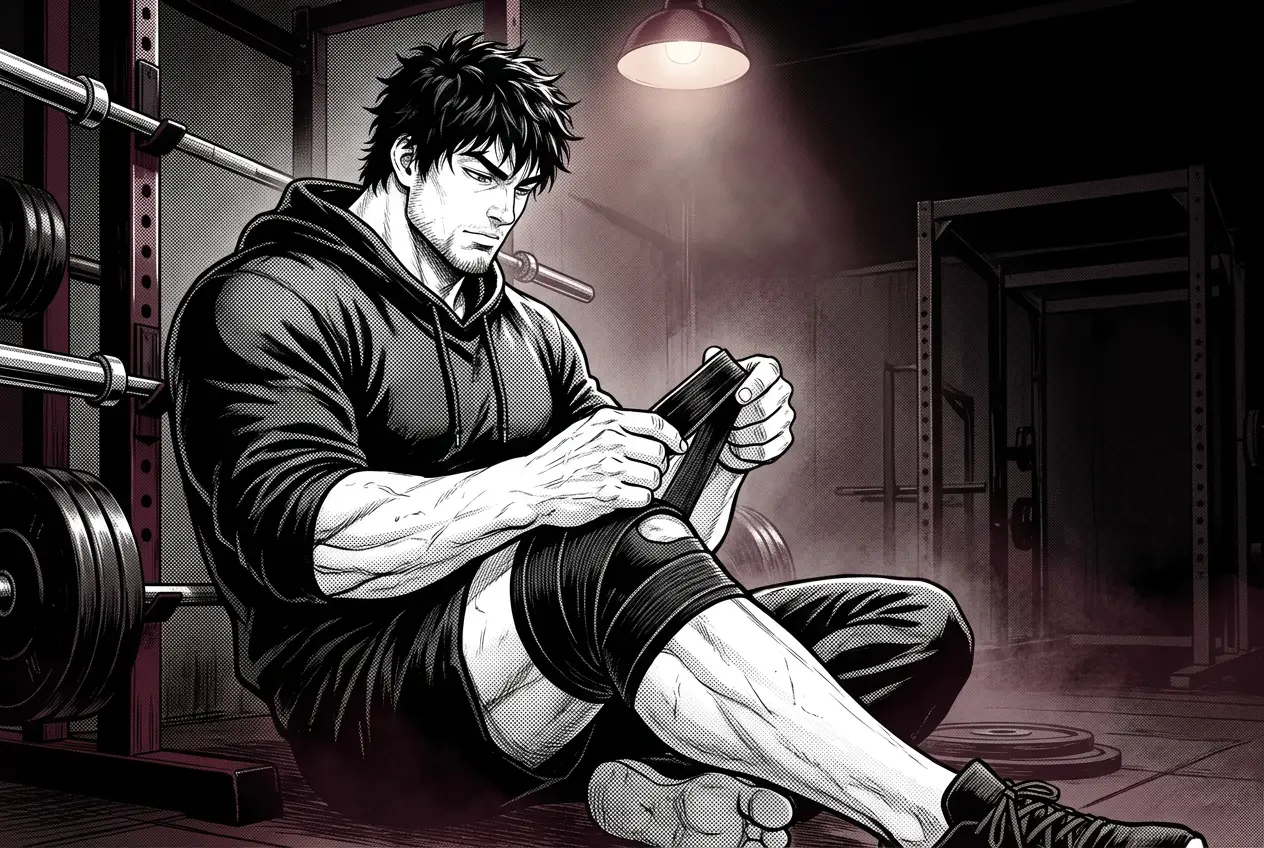
The comeback arc is usually less dramatic in real life. No training montage, no secret technique. Recovery happens through boring things repeated consistently—and that is exactly why promises of shortcuts spread so fast in gym culture.
This article looks at two of the most talked-about recovery compounds, BPC-157 and TB-500, and separates what the research shows from what the internet says.
Recovery is where adaptation happens
Training is the stimulus. It creates stress and small amounts of damage. Adaptation—stronger tissue, more muscle, better conditioning—happens afterwards, during recovery. If stress consistently outpaces recovery, performance stalls and injury risk rises.
For bigger lifters moving heavy loads, joints, tendons and connective tissue often become the limiting factor long before muscle does.
The boring recovery basics that actually have evidence
These aren't a supplement stack. They're the fundamentals that most human evidence supports:
- Sleep. Sleep loss impairs performance, mood, pain perception and recovery processes; athletes are commonly advised to prioritize it (Fullagar et al., Sports Med 2015).
- Appropriate training load. Sudden spikes in volume or intensity are a common setup for overuse injuries.
- Nutrition and protein. Adequate energy and protein support tissue remodelling.
- Rehabilitation. A diagnosis and structured, progressive loading remain the standard approach for most tendon and muscle injuries.
- Progressive return to activity. Getting back to heavy training gradually, guided by function rather than a calendar.
- Time. Connective tissue remodels slowly. Patience is part of the protocol.
Why BPC-157 became so popular
BPC-157 ("body protection compound") is a synthetic 15-amino-acid peptide based on a sequence from a protein found in gastric juice. It became popular in bodybuilding and online peptide communities through a combination of dramatic rodent studies, strong anecdotes and the very real frustration of being injured.
Popularity, though, is not the same as demonstrated clinical effectiveness.
What BPC-157 research actually shows
Cell research: laboratory experiments suggest BPC-157 may influence cell migration, blood-vessel growth signalling and growth-factor pathways involved in repair. These show plausible mechanisms, not outcomes in people.
Animal research: most of the literature comes from rodent studies, many from a single research group, reporting faster healing of tendon, ligament, muscle and gut injuries (Gwyer et al., Cell Tissue Res 2019). Rodent tendon and gut findings cannot be directly extrapolated to human injuries, dosing or safety.
Human research: human evidence is very limited. A small retrospective report described people with knee pain who received BPC-157 injections and reported symptom improvement (Lee & Padgett, 2021). It had no control group, relied on self-reported outcomes and could not rule out natural recovery or other treatments. That makes it a signal worth studying, not evidence that BPC-157 heals human tissue. Well-designed randomized controlled trials in injured people have not been published.
Evidence level — mostly preclinical, limited human. For a deeper breakdown, including a claim-versus-evidence table, see BPC-157 and TB-500: What Lifters Should Know About Recovery Claims.
What people mean by TB-500
Thymosin beta-4 (Tβ4) is a naturally occurring 43-amino-acid protein involved in cell movement and tissue repair. It has been studied in wound healing, cardiac and eye research (Goldstein et al., 2012).
"TB-500" is a commercial term, usually used for a short synthetic fragment associated with one active region of Tβ4—but products labelled TB-500 vary, and the label alone doesn't tell you what's in the vial. Research on full-length thymosin beta-4 cannot automatically be applied to a fragment or to a differently characterized commercial product.
What the evidence shows
Mechanistic research: Tβ4 binds actin and influences cell migration and blood-vessel formation—plausible routes to repair.
Animal evidence: animal studies of Tβ4 report benefits in wound, cardiac and other injury models.
Human evidence: small clinical studies have tested specific Tβ4 formulations for particular conditions such as certain eye and skin wounds. None establishes that TB-500 speeds recovery from training injuries in lifters. Evidence for individual substances also doesn't show that combining them works better or is safe.
Why anecdotes spread faster than clinical trials
People who report improvement usually are describing something real. The question is what caused it. Several things can make almost anything look effective:
- Regression to the mean. People try new things when pain is at its worst, and pain often eases on its own afterwards.
- Concurrent rest. Starting a compound usually coincides with backing off training.
- Physical therapy. Rehab exercises are often happening at the same time.
- Reduced training load. Less stress on the tissue, more time to adapt.
- Placebo and context effects. Expectation genuinely changes how pain feels.
- Natural healing. Many soft-tissue injuries improve over weeks regardless.
Controlled trials exist precisely to separate these effects. Until they're done, a hundred convincing stories still can't tell us what the compound itself did.
Research compound does not mean proven therapy
Regulatory status as of 26 September 2026: neither BPC-157 nor TB-500 is an FDA-approved medicine. FDA has identified BPC-157 among bulk substances that raise significant safety concerns for compounding, citing limited safety data and risks such as immune reactions and impurities (FDA). Both BPC-157 and thymosin beta-4 and its fragments are prohibited in competitive sport under the WADA Prohibited List; competitive athletes should check the current list and their federation's rules directly.
Long-term human safety data are largely missing, and research-labelled products may differ from what is described on the label. This article does not provide dosing, injection, cycling or stacking information, and nothing here is individual medical advice. If an injury isn't improving, a sports-medicine clinician or physical therapist is the right next step.
Build a body that can survive the next arc
The best recovery strategy is the one that keeps you training for years: manageable load, real sleep, enough protein, early attention to niggles and a structured return when something goes wrong. It isn't dramatic, but it's what lets strong people keep getting stronger.
Every arc ends. The goal is to be ready for the next one.
Science check
Analysis // 03What we know
- Sleep, appropriate load management and progressive rehabilitation support recovery from training and injury.
- BPC-157 has produced healing signals in many rodent experiments.
- Neither BPC-157 nor TB-500 is an FDA-approved medicine, and both appear on WADA's prohibited list.
What we think
- Some mechanisms seen in animals, such as effects on blood-vessel growth, could be relevant to tissue repair.
What we don't know yet
- Whether BPC-157 or TB-500 improves human injury recovery in controlled trials.
- Their long-term safety in people, and what commercial products actually contain.
Power scale · strength of evidence
Rates how strong the science is — not how well anything works. Nothing here is a product rating.
- Sleep and load management for recoveryHuman clinical evidence
- BPC-157 for human injury recoveryLimited human evidence
- BPC-157 tendon and gut healing in rodentsPreclinical evidence
- TB-500 fragment benefits in peopleMechanistic hypothesis
Training log // 03
- 01 · Sleep
- The most reliable recovery tool available—protect it first.
- 02 · Training
- Reduce load, not purpose. Train around injuries with a plan.
- 03 · Protein
- Adequate protein supports tissue remodeling during rehab.
- 04 · Recovery
- Get a diagnosis for injuries that linger or limit function.
- 05 · Steps
- Gentle movement usually beats complete rest for most soft-tissue issues.
General, mainstream habits — not a personal plan.
Limitations
Educational information only. This article does not provide medical advice, diagnosis, dosing, or treatment recommendations. Talk with a qualified clinician about your own health.
Sources
- 1.Fullagar HHK et al. Sleep and athletic performance. Sports Med, 2015.
- 2.Gwyer D et al. Gastric pentadecapeptide BPC 157 and its role in accelerating musculoskeletal soft tissue healing. Cell Tissue Res, 2019.
- 3.Lee E, Padgett B. Intra-articular injection of BPC 157 for multiple types of knee pain. Altern Ther Health Med, 2021.
- 4.Goldstein AL et al. Thymosin β4: a multi-functional regenerative peptide. Expert Opin Biol Ther, 2012.
- 5.U.S. FDA. Bulk drug substances nominated for use in compounding — safety risks.
- 6.World Anti-Doping Agency. Prohibited List.
Your next arc starts with better information.
Body composition, metabolic health, training and emerging research—without the hype. Plus occasional updates from our affiliated research business, TPG Bioscience.
Educational information only. This article does not provide medical advice, diagnosis, dosing, or treatment recommendations. Talk with a qualified clinician about your own health.
Related articles
BPC-157 and TB-500: What Lifters Should Know About Recovery Claims
Injury makes fast-recovery claims compelling. Here is the difference between animal repair experiments, small human reports, and demonstrated return-to-training outcomes.
Recomp Report Editorial Team · 21 September 2026
The Training Arc: How to Rebuild Yourself When You've Always Been the Big Guy
You've been big, you've gotten strong, and now you want to change your body. Here's how to approach fat loss and recomposition without pretending you're starting from zero.
Recomp Report Editorial Team · 26 September 2026
More Growth Hormone, More Muscle? CJC-1295 and Ipamorelin Explained
Hormone changes are biological signals, not automatic proof of more muscle, strength, better sleep, or faster recovery.
Recomp Report Editorial Team · 21 September 2026