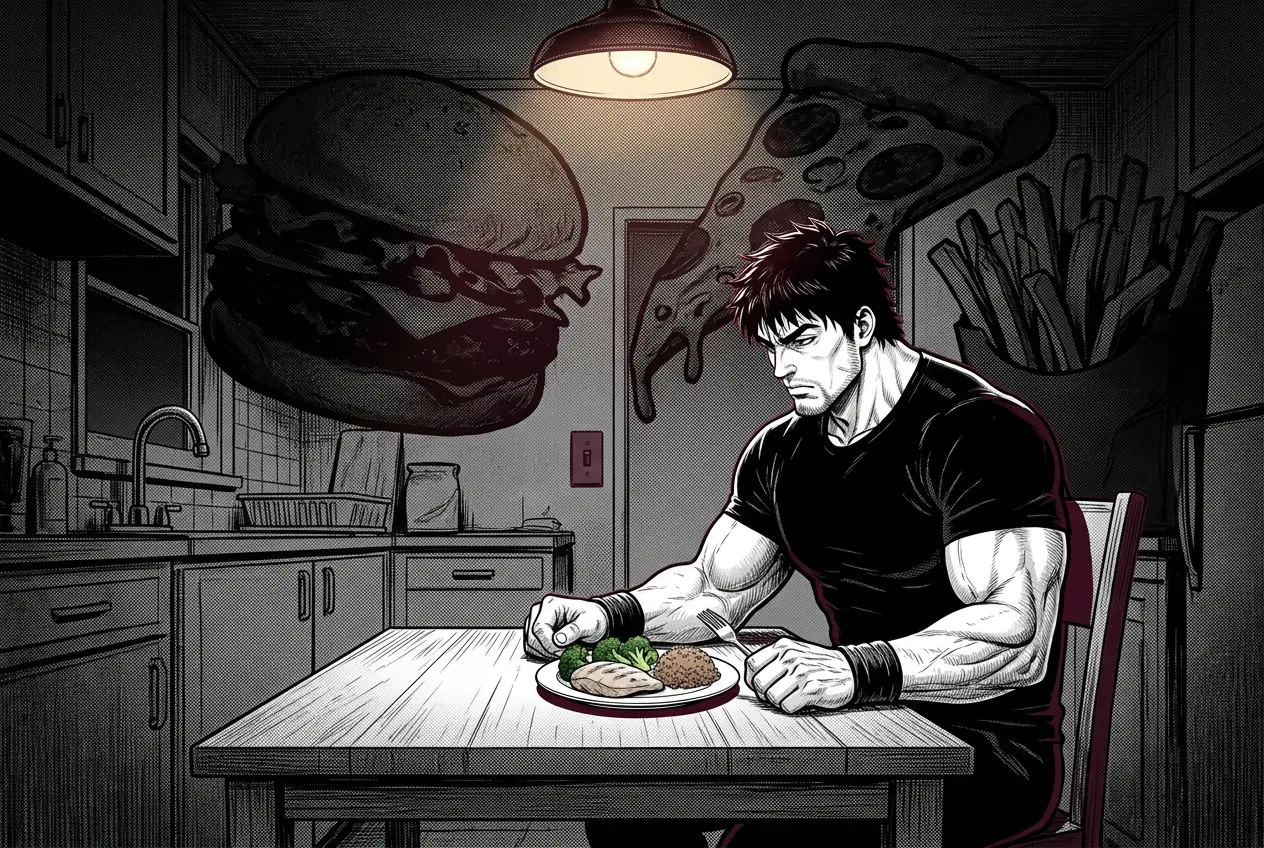
The Hunger Arc
The Hunger Arc: Why Appetite Feels Like the Final Boss
Hunger is not a character flaw—it is a regulated biological system that pushes back when you diet. What research shows about appetite hormones, food environment, protein, sleep and stress.
Key takeaways
- 1.Appetite is regulated by hormones, the nervous system and the food environment—not willpower alone.
- 2.After weight loss, appetite signals tend to rise and fullness signals fall, and these shifts can persist for a year or more.
- 3.Protein, fiber, sleep and food-environment design have the strongest human evidence for making hunger manageable.
Every long series saves the hardest opponent for late in the story. For most people who diet, that opponent is not the training, the tracking or the meal prep. It is hunger—the quiet, persistent feeling that shows up on schedule and gets louder the longer the diet runs.
Hunger feels personal. It is not. Appetite is a regulated biological system, shaped by hormones, the nervous system, sleep, stress and the food environment around you. Understanding that system does not make hunger disappear, but it explains why willpower alone is a bad strategy—and what actually has evidence behind it.
Appetite is a system, not a character trait
The body defends its energy stores. When you eat less and lose weight, appetite-related hormones shift in a direction that pushes you to eat more: signals that stimulate hunger tend to rise, while signals that report fullness tend to fall. In a frequently cited human study, these hormonal shifts were still measurable a year after weight loss (Sumithran et al., 2011). Evidence level — human study with a year of follow-up: appetite hormones stayed altered long after the diet ended. What it does not establish: that regain is inevitable—only that the biological pressure is real and persistent.
Reviews of the biology of weight regain describe the same picture from multiple angles: energy expenditure drops, appetite rises, and the brain's response to food cues sharpens (MacLean et al., 2011). None of this is a personal failure. It is physiology doing its job.
The food environment is part of the system
Hunger is not only internal. What surrounds you matters. In a tightly controlled inpatient study, people offered an ultra-processed diet ate roughly 500 more calories per day than when offered an unprocessed diet matched for presented calories, sugar, fat, fiber and sodium—and they gained weight in two weeks (Hall et al., 2019). Evidence level — small controlled human feeding study: the processing itself changed how much people ate. What it does not establish: that every processed food has this effect in every setting.
The practical reading is not "never eat processed food." It is that an environment full of hyper-palatable, easy-to-eat food makes appetite harder to manage, no matter how disciplined you are. Designing your environment—what is in the house, what is on the counter, what you eat first—is a legitimate strategy, not a workaround for weak willpower.
What actually has evidence behind it
Protein and fiber. Higher-protein diets consistently show better satiety and better lean-mass retention during weight loss in human trials (Leidy et al., 2015). Fiber-rich, minimally processed foods add volume and slow eating. Neither removes hunger; both make it more manageable per calorie.
Sleep. Short sleep shifts appetite hormones in the direction of more hunger and less fullness, and short sleepers report stronger cravings for energy-dense food (Spiegel et al., 2004). If hunger feels unmanageable, sleep is one of the first dials worth checking.
Exercise is complicated. A review of exercise and appetite found that training does not simply "earn" hunger in a one-to-one way—responses vary widely between people, and some individuals compensate by eating more while others do not (Blundell et al., 2015). Exercise still earns its place for health and body composition; just do not assume it cancels out intake automatically.
Expect the pressure to persist. Because hormonal adaptations to weight loss can persist for a year or more, the phase after the diet matters as much as the diet itself. Planning for maintenance—rather than treating the end of the cut as the finish line—matches what the biology actually does.
Where the evidence runs out
Most appetite research comes from people with obesity or from tightly controlled feeding studies, not from lean lifters finishing a cut. How strongly these mechanisms apply to a trained person at 12% body fat is less certain. And while medications that act on appetite pathways produce large effects in trials of people with obesity, that is a clinical question for a clinician—not a body-composition tip.
The honest summary: hunger during a diet is normal, biological and persistent. The tools with real human evidence are boring—protein, fiber, sleep, food environment, realistic rates of loss, and a plan for after the diet. The final boss is not beaten in one fight. It is managed, arc after arc.
Science check
Analysis // 05What we know
- Appetite is regulated by hormones, the nervous system and the food environment—not willpower alone.
- After weight loss, hunger signals tend to rise and fullness signals fall, and these shifts can persist for a year or more.
- Ultra-processed food environments drive higher calorie intake in controlled human feeding studies.
What we think
- Higher protein and fiber intakes improve satiety during weight loss for many people.
- Short sleep shifts appetite hormones toward more hunger and stronger cravings.
What we don't know yet
- How strongly these mechanisms apply to lean, trained lifters finishing a cut.
- Which long-term appetite-management strategy works best for a specific person.
Power scale · strength of evidence
Rates how strong the science is — not how well anything works. Nothing here is a product rating.
- Hormonal adaptations to weight loss persist a year or moreHuman clinical evidence
- Ultra-processed diets increase calorie intake (controlled feeding)Human clinical evidence
- Protein and fiber for satiety during weight lossHuman clinical evidence
- Appetite research applied to lean lifters mid-cutMechanistic hypothesis
Training log // 05
- 01 · Protein
- Anchor every meal. Satiety per calorie is the game now.
- 02 · Food environment
- What is in the house is a strategy. Design it on purpose.
- 03 · Sleep
- Short sleep turns the hunger dial up. Protect it first.
- 04 · Fiber
- Volume and slow eating make the deficit easier to live with.
- 05 · After the diet
- Plan maintenance before you need it. The pressure persists.
General, mainstream habits — not a personal plan.
Limitations
Educational information only. This article does not provide medical advice, diagnosis, dosing, or treatment recommendations. Talk with a qualified clinician about your own health.
Sources
- 1.Sumithran P et al. Long-term persistence of hormonal adaptations to weight loss. N Engl J Med, 2011.
- 2.Blundell J et al. Appetite control and energy balance: impact of exercise. Obes Rev, 2015.
- 3.Hall KD et al. Ultra-processed diets cause excess calorie intake and weight gain. Cell Metab, 2019.
- 4.Leidy HJ et al. The role of protein in weight loss and maintenance. Am J Clin Nutr, 2015.
- 5.Spiegel K et al. Sleep loss and appetite-regulating hormones. Lancet / Ann Intern Med studies.
- 6.MacLean PS et al. Biology's response to dieting: the impetus for weight regain. Am J Physiol Regul Integr Comp Physiol, 2011.
Your next arc starts with better information.
Body composition, metabolic health, training and emerging research—without the hype. Plus occasional updates from our affiliated research business, TPG Bioscience.
Educational information only. This article does not provide medical advice, diagnosis, dosing, or treatment recommendations. Talk with a qualified clinician about your own health.
Related articles

The Cut Arc: How to Lose Fat Without Losing the Muscle You Built
The cut is where you reveal what you built—but cut too hard and you reveal a smaller, weaker you. What research says about rate of loss, protein, training and diet breaks.
Recomp Report Editorial Team · 29 September 2026

The Plateau Arc: When You're Stronger but the Fat Loss Stops
Why does fat loss slow down even when you're still training? Understand metabolic adaptation, appetite, movement and what newer incretin research actually shows.
Recomp Report Editorial Team · 26 September 2026

Beyond the Scale: Retatrutide, Tesamorelin, and the Science of Body Composition
For lifters, body weight is only one metric. This guide separates trial results on fat and lean mass from claims about muscle retention, strength, and physique.
Recomp Report Editorial Team · 21 September 2026